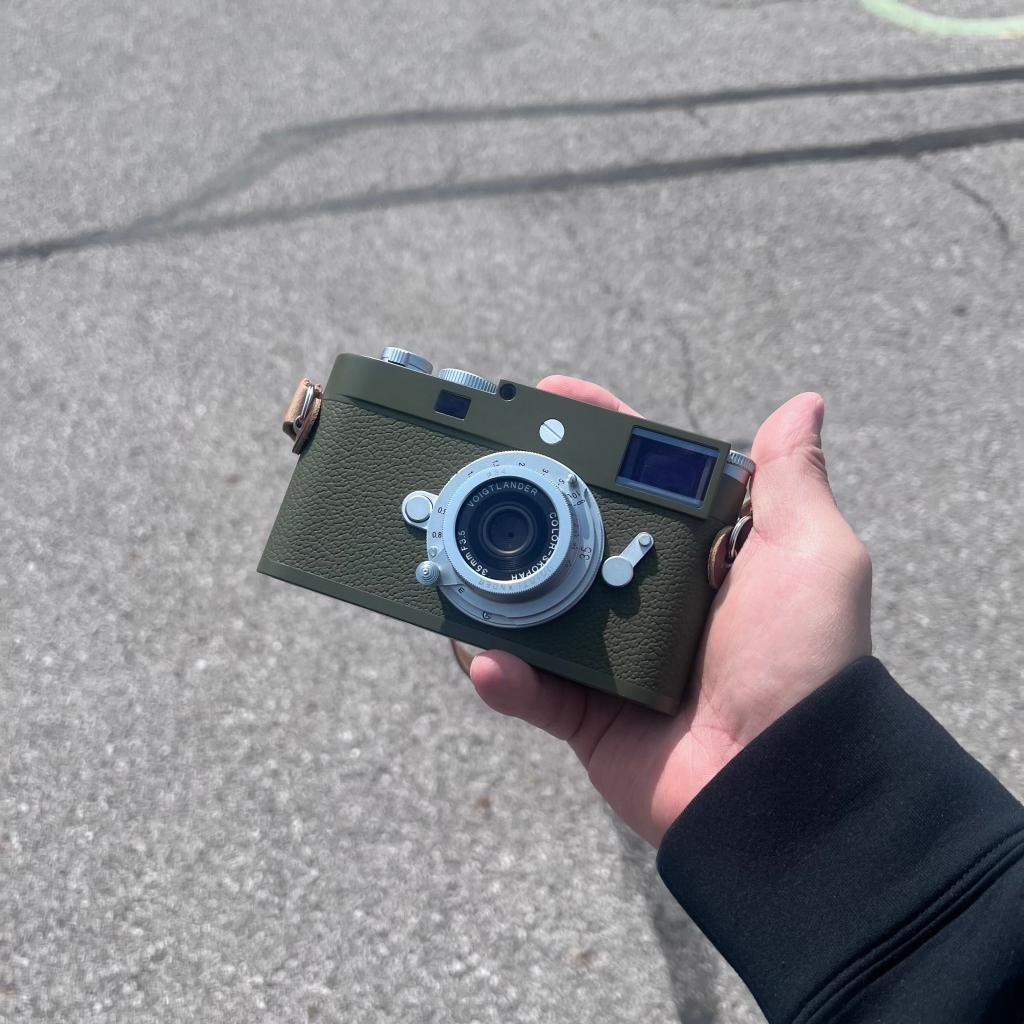

My history with Leica
My introduction to Leica came from a couple of different avenues. The first was actually in middle school history class, when I was studying WWII and the Holocaust. Many of the iconic photographs from that era—like Yevgeny Khaldei’s Raising a Flag Over the Reichstag—were taken with a Leica. At the time, I wasn’t into photography yet; my interest was more rooted in history.
My first purchase of a Leica M body came during the pandemic, after I stumbled upon Ian Wong’s Digital Darkroom YouTube video on the Leica M6. By then, I had been practicing photography as a hobby for several years. I felt like I had outgrown my Minolta X-700 and was ready for a more robust system—something I could truly invest in.
When I realized that Leica stood for Leitz Camera—the same brand I had learned about back in middle school—something clicked. I knew it was the camera system I wanted to explore, born from my love for history, documentation, and photography. And the rest, as they say, was history.
My transition to a digital Leica
I’m sharing this brief personal history of my introduction to Leica because I think it plays an important role in how I connect with Leica’s latest iteration of the digital M rangefinder. My first digital rangefinder was the M10-P, which I picked up in 2022. After a few months of shooting with it, I transitioned to the M11. Around that time, I sold off most of my film gear to invest more seriously in digital photography and decided to give the Leica M11 a proper spin—even though it seemed like every digital Leica sparked some kind of controversy.

I loved the M11. It felt like my M6, but with a bunch of shiny bells and whistles.
As time went on, I became curious about the different M11 variants. That’s when I started going back and forth between the M11, M11 Monochrom, and M11-P. Some of the best photos I’ve taken between 2022 and 2024 came from those cameras.
Looking purely at the M11 series on its own, I believe this generation of the M body redefines what a digital rangefinder can—and should—be.
Why the M11 is a true digital successor
Since its inception, Leica has consistently prioritized quality, portability, and versatility in every iteration of its cameras. When the first Leica prototypes emerged in the early 20th century—most notably the Leica I in 1925—they marked a revolutionary shift in the photographic world. These were the first mass-produced cameras to use 35mm film, a format originally designed for cinema. By adapting it for still photography, Leica made cameras significantly more compact and accessible, helping establish 35mm as the standard film format for decades. This innovation laid the foundation for the modern rangefinder.
In many ways, the Leica M11 carries that legacy forward. It embodies the same core principles that defined the earliest Leicas: elegant simplicity, mechanical precision, and a focus on the photographer’s experience. What truly sets the M11 apart from other digital cameras isn’t just its heritage or iconic design—it’s the way it seamlessly blends modern technology with Leica’s timeless values. From its full-frame BSI sensor and refined ergonomics to its intuitive manual controls and compact body, the M11 continues the tradition of creating cameras that fade into the background and let you focus purely on the act of seeing.
Through my time using the M11 series, I’ve found several features that truly distinguish it from previous digital cameras:
- Pixel binning for flexible resolution and low-light performance
- Live view for precise framing and focus
- Built-in internal storage for added convenience and redundancy
- A back-side illuminated (BSI) sensor offering improved dynamic range
- Enhanced metering modes for more accurate exposures
- The removal of the traditional baseplate, making battery and card access quicker
- Seamless integration with the Leica FOTOS app for wireless image transfer and control
These new additions make a strong case for the M11 series, adding meaningful versatility to a platform already celebrated for its exceptional build and image quality. Features like pixel binning and live view have become part of my regular shooting workflow, allowing me to adapt to different scenarios with ease.

Historically, M rangefinders have been known for their charm and simplicity—but also for their limitations. Framing accuracy and metering were once common pain points, particularly for those transitioning from more modern systems. The M11 addresses those concerns while still preserving the soul of a mechanical rangefinder. The new metering modes and sensor-based exposure control offer far more reliability and creative flexibility, making it easier to stay in the moment and capture images intuitively.
Why M11? Why not the M11?
The most difficult question. As much as I’ve enjoyed the M11—and will likely own one again in the future—I’ve ultimately decided to part ways with it for now.
Most reviewers point out how expensive Leica M bodies are, and I completely agree. For most users, it makes more sense to invest in lenses first and the camera body second, as the glass is where you’ll notice the most significant difference. Of course, if you have the means to afford both, then the M11 paired with quality Leica lenses is arguably the best digital rangefinder experience available today.
For me personally, the decision to let go of the M11 came down to simplifying my gear setup. I wanted a hybrid camera that could also shoot video—a limitation of the M11 not because of a flaw, but because of its focused purpose. I already have two cameras that serve my needs perfectly: the Leica M6 for rangefinder shooting and film, and the Lumix S9 (now upgraded to the S5IIX) for both high-quality stills and video.
When traveling or shooting on the go, I’ve found that I never enjoy carrying more than two cameras. Over time, I’ve gravitated toward a setup that allows me to shoot freely, without overthinking my gear. The M6 gives me that pure, tactile shooting experience with film, while the Lumix handles everything else—photo, video, and quick social media-ready content. And the best part? I can acquire both of these for less than the cost of a single M11 body.
Final thoughts
The Leica M11 is, in many ways, the most refined digital M body Leica has ever made. It maintains the brand’s deep-rooted philosophy of simplicity and precision, while thoughtfully integrating modern tools that expand what a rangefinder can do in today’s digital world.
For photographers who resonate with the Leica ethos—those who value a slower, more intentional shooting process, built quality, and timeless design—the M11 offers a deeply satisfying experience. It’s not trying to be everything for everyone, and that’s exactly what makes it special.
I may have let go of mine for now, but the M11 has left a lasting impression on how I see the intersection of modern photography and tradition. It reminded me that tools can shape not just the images we create, but how we engage with the act of seeing itself.

 kinda grainy