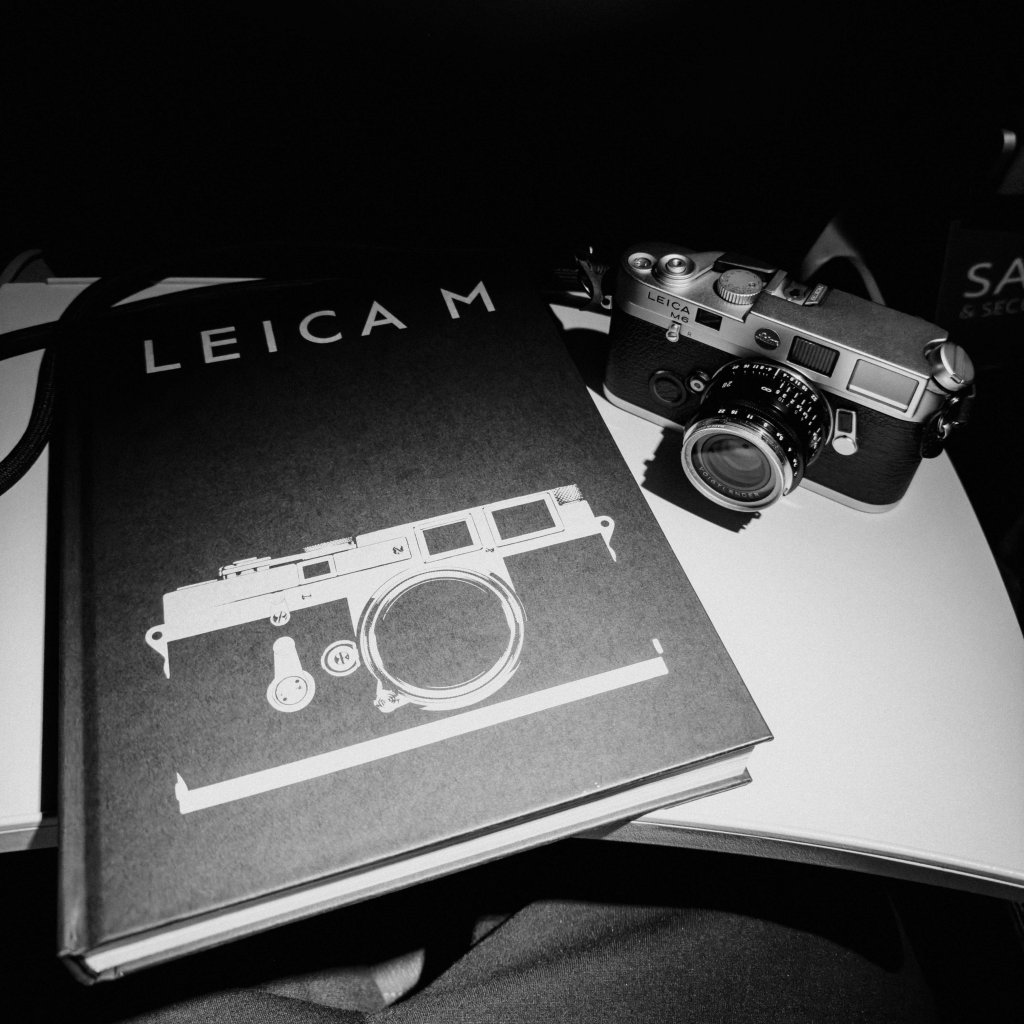
I didn’t think I would ever get my hands on a copy of this book.
I quite literally traveled the world searching for it, but couldn’t find it in stock. Japan had no copies remaining. South Korea had a copy I was able to flip through, but it was only a sample; all available stock had sold out. In an ironic twist, I was in the Meatpacking District Leica store in New York City, enjoying all the cameras when I noticed it: a short stack of five copies remaining, high on a shelf. I did a double take. Yes, there they were. Like a treasure hunter, I had found them. I immediately asked a store employee if they were for sale. When she said yes, I swiped my credit card, almost unable to believe my good fortune.
At the end of a long weekend in the city, tired from miles and miles of street photography, I sat down in my aisle seat on the plane, lowered my tray table, popped in my AirPods, and turned on some jazz, excited to take in the book for the first time.
As the foreword states, this book is a “Happy 70th Birthday!” to the Leica M system. It wonderfully blends the cameras with the photographers. Joel Meyerowitz sums it up perfectly in the first pages of the book: “Carrying a Leica is like a free pass to the unexpected.” Turning the page from there presents the viewer with a richly vibrant double-page spread of a 1967 image of Joel’s. The moment is indeed full of surprises. One woman’s hat is being windblown down a set of stairs, while another woman’s hat is being held on for dear life. An unexpected moment, a split second capture. The printing quality is fabulous, a soft sheen making the colors pop. The coolest part is the context in the lower-left corner: the location and the camera. As a Leica enthusiast, this was exactly the information I craved. Paris, Leica M2. And this is when it all came together for me. I was immediately transported back in time to a day I didn’t even experience. It had occurred decades before I was born. But as I thought of my own Leica M6, for just a second, I felt what it was like to be right there with Joel. What it felt like to pull the rangefinder up to my eye, to see the world as it was through the bright and crisp viewfinder, to fit the moment within the framelines. I’ve never been to Paris and I wasn’t alive in 1967, but for an instant, I could visualize the scene as he would have. This is the power of M. My M6 was manufactured 25 years after this image was made, yet even in 2025, I can capture a moment the same way Joel did all those years ago. This is why I love this brand and book. The rich heritage and history. The seamless blending of photographer and camera. How many products grant the user an experience so similar to one nearly 50 years prior?
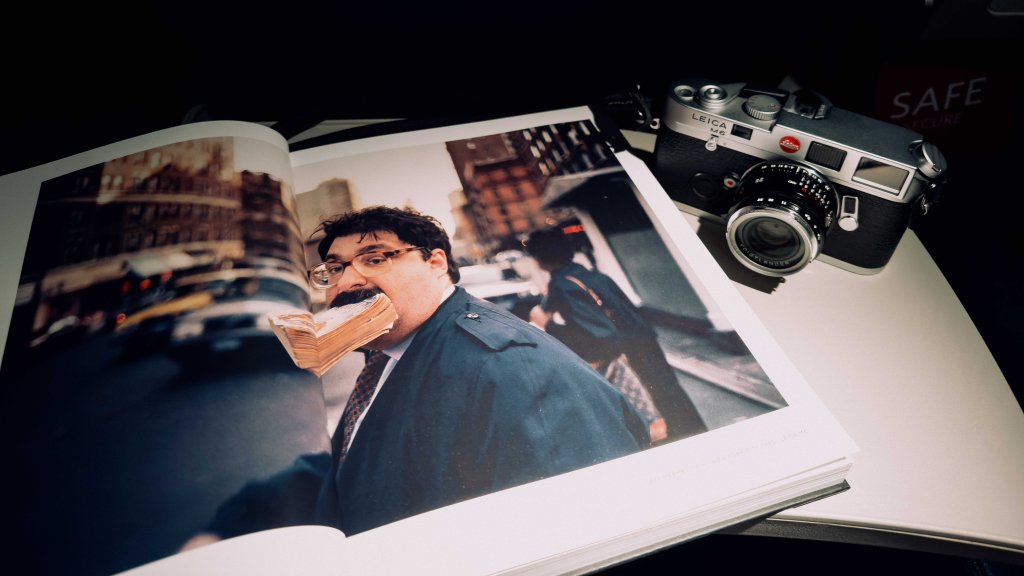
More unexpected moments awaited over the next several pages as a “who’s who” of photographers works fill the pages. Elliott Erwitt captures a comedic scene of a dog sitting on its owners lap. Jeff Mermelstein snags a subject with a book in his mouth on a New York street. Bruce Gilden frames two men who appear to be brothers sharing a laugh next to their car. This section features iconic photographers whose work defines our hobby. Images were captured with a wide range of Leica models—M4s, M6s, MPs, M240s, M9s, M10s, and M11s—spanning nearly six decades and connecting generations of photographers. Moments from 1976 to 2023, all in a matter of pages.
As I continue flipping forward, I arrive at Destination: Rangefinder, an essay on the history of Leica Camera, followed by some thoughts from Joel Meyerowitz, Sarah M. Lee, and Matt Stuart about their own journeys using the M system. Meyerowitz goes over his process for being able to still be present in the world even when the camera is up to his eye. Lee discusses her ability to time up the moment with precision while feeling as if her M is simply a part of her. Stuart shares his love for the form factor and portability of the M system. All three photographers have their own reasons for preferring the M system and give us a glimpse into how they react to situations they encounter.
The following section features prominent and saturated colors from across the globe, once again from an all-star cast of photographers. Miami, Melbourne, Macao- all on M cameras. Each color palette as fun as the last. Each image grabs and holds my full attention.
I then embark on a journey into the world of monochrome. As Trent Parke so whimsically states, “I am forever chasing light. Light turns the ordinary into the magical.” There is no more pure way of capturing light than in only black and white tones. Some images feature the soft palette of blacks blending into grays and whites and others highlight the stark contrast between light and shadow, allowing sections of the photo to plunge into darkness. Black and white draws the eye to only the most important point of the photo, with everything else fading into oblivion. Most of my favorite images from this section were captured with analog M bodies, allowing the natural textures of the film grain to add an extra element. Sandwiched between these lovely photographs is a brief conversation about what captures this light, the M family of lenses. We see the microscopic parts of each Summilux and Summicron assembled by hand with a pinpoint zero-tolerance policy for error. The way each lens renders light is unique, taking on character wholly of its own. The M line of lenses is among the finest ever made.
The visual beauty continues to overwhelm: the weathered cliffs of Iceland, a majestic whale near Tonga, the steamy winter streets of New York, rain-soaked Mongolia, snow-covered Berlin—all in pure monochromatic glory.
We once again change gears and read about the dawn of a new era of M, the digital sensor bodies and how they came to be. Gear aficionados such as I rejoice as we are shown behind-the-scenes images in the Leica headquarters of camera and lens assembly, showing the true German engineering prowess and master craftsmanship in action. Then, on page 196, we are introduced to the reason why this book exists, the Leica M3 and its various versions. From there, each ensuing M body gets its time to shine all the way through the M11. Listed with select photos and indexed chronologically, each M special edition is highlighted – and there are a lot of them! And what better way to wrap up this birthday book than to show us the 70th edition Leica M camera released in 2024? Pure mechanical perfection and based on the M3, it is a wonderful tribute to both the past and the future of the most iconic cameras ever made. Releasing this camera as an analog model is a classy nod to both the past and present.
If you ever find yourself with a lucky opportunity like I had to pick up a copy of this book, I highly encourage it. It tastefully combines the cameras to the photographers along with their images and provides a beautiful blend of photographic styles and subjects as well as a fascinating case study of the M family of bodies and glass.
Very often, some are quick to criticize photographers for being so enamored with their cameras and lenses; but this book begs the question: is that really so wrong? Can the two really be separated when one has such a strong effect on the other? And as I glanced up to my own M6, I knew the answer in my heart.

 kinda grainy