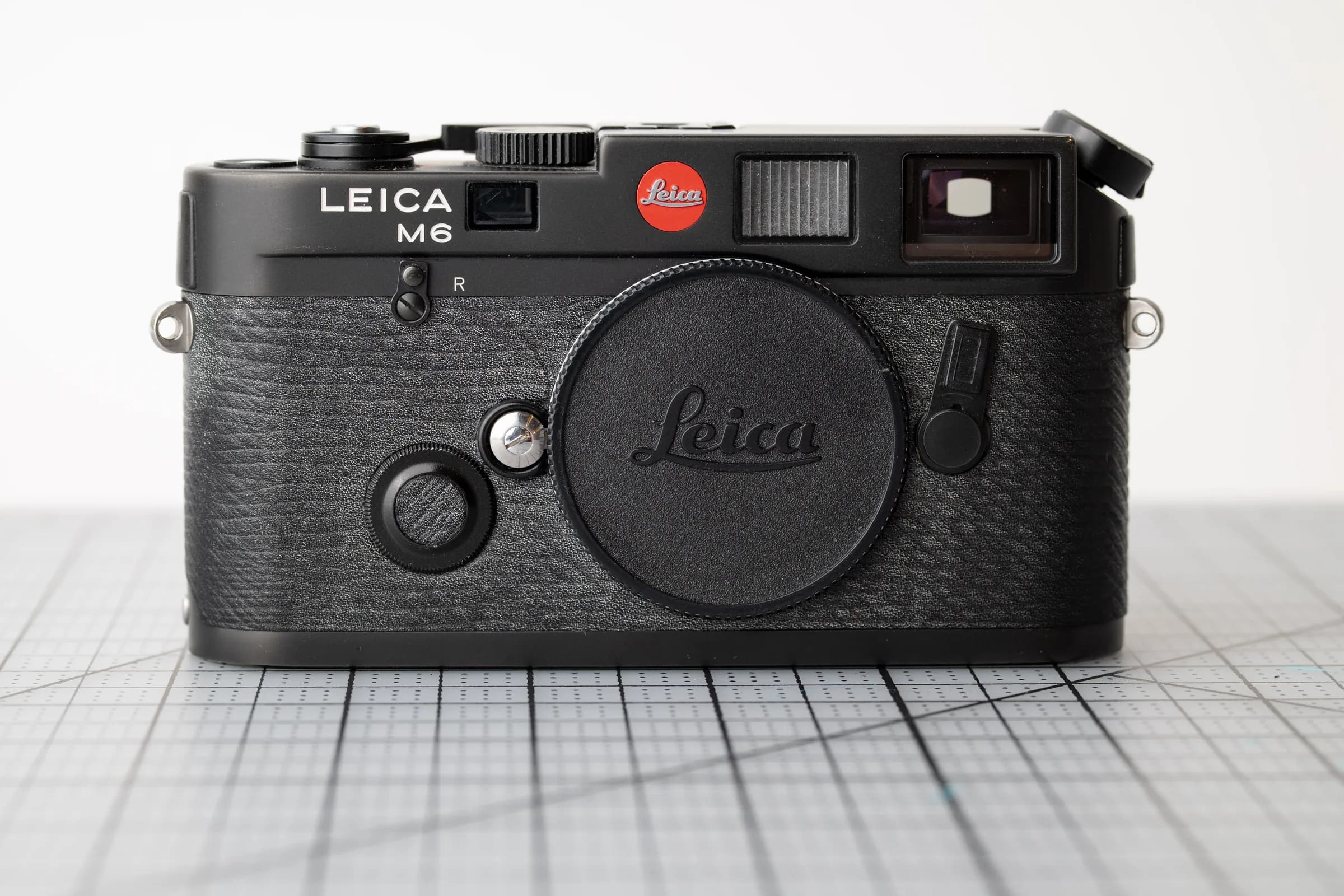
The Leica M6 is a 35mm rangefinder with a mechanically timed shutter and a built-in light meter. The battery only runs the meter, so everything else keeps working when it dies.
Leica M6
35mm film rangefinder, 1984–1999
Updated
Quick facts
- Brand
- Leica
- Type
- 35mm film rangefinder
- Made
- 1984–1999
- Production total
- 132,454
- Preceded by
- Leica M4-P
- Followed by
- Leica M6 TTL
Production
Leica made the M6 from 1984 to 1999, in Wetzlar. Apart from the meter it’s mechanically the same camera as the M4-P. The M6 TTL arrived in 1998 and the two were sold side by side for about a year.
In 2022 Leica brought the M6 back. Inside, the reissue is an MP with a 0.72x viewfinder. Outside, it copies an early M6, with a red Leitz roundel, “Ernst Leitz Wetzlar Germany” on the top plate and no plastic anti-rub inserts. Its top and bottom plates are black-chromed brass instead of the original zinc alloy, and the meter uses the MP’s three-LED readout.
Production figures by year
As listed in the Leica Pocket Book. These probably count serial numbers Leica set aside each year rather than cameras finished that year, which would explain years with none.
- 1984
- 2,000
- 1985
- 12,600
- 1986
- 14,070
- 1987
- 7,000
- 1988
- 14,000
- 1989
- 3,625
- 1990
- 6,500
- 1991
- 9,000
- 1992
- 11,500
- 1993
- 6,251
- 1994
- 8,985
- 1995
- 12,750
- 1996
- 6,225
- 1997
- 10,997
- 1998
- 4,800
- 1999
- 2,151
- Total:
- 132,454
- Black chrome:
- 75,453
- Silver chrome:
- 51,725
- Special editions:
- 5,276
Identification
The M6 put through-the-lens metering into a standard-size M body. (The M5 had it first, in a bigger body.) A silicon cell reads the light reflected off a white spot in the middle of the shutter curtain.
Press the shutter button halfway and the meter turns on. Two triangular LEDs in the viewfinder show which way to turn the aperture ring or the shutter dial, and the exposure is right when both glow evenly.
The battery sits where earlier Ms had a self-timer, and film speed is set on a dial on the hinged back.
To date a body: early top plates read “Ernst Leitz Wetzlar GmbH”. From 1986, bodies have plastic anti-rub inserts at the ends of the top plate, and from 1988 the red roundel says Leica instead of Leitz.
Gallery
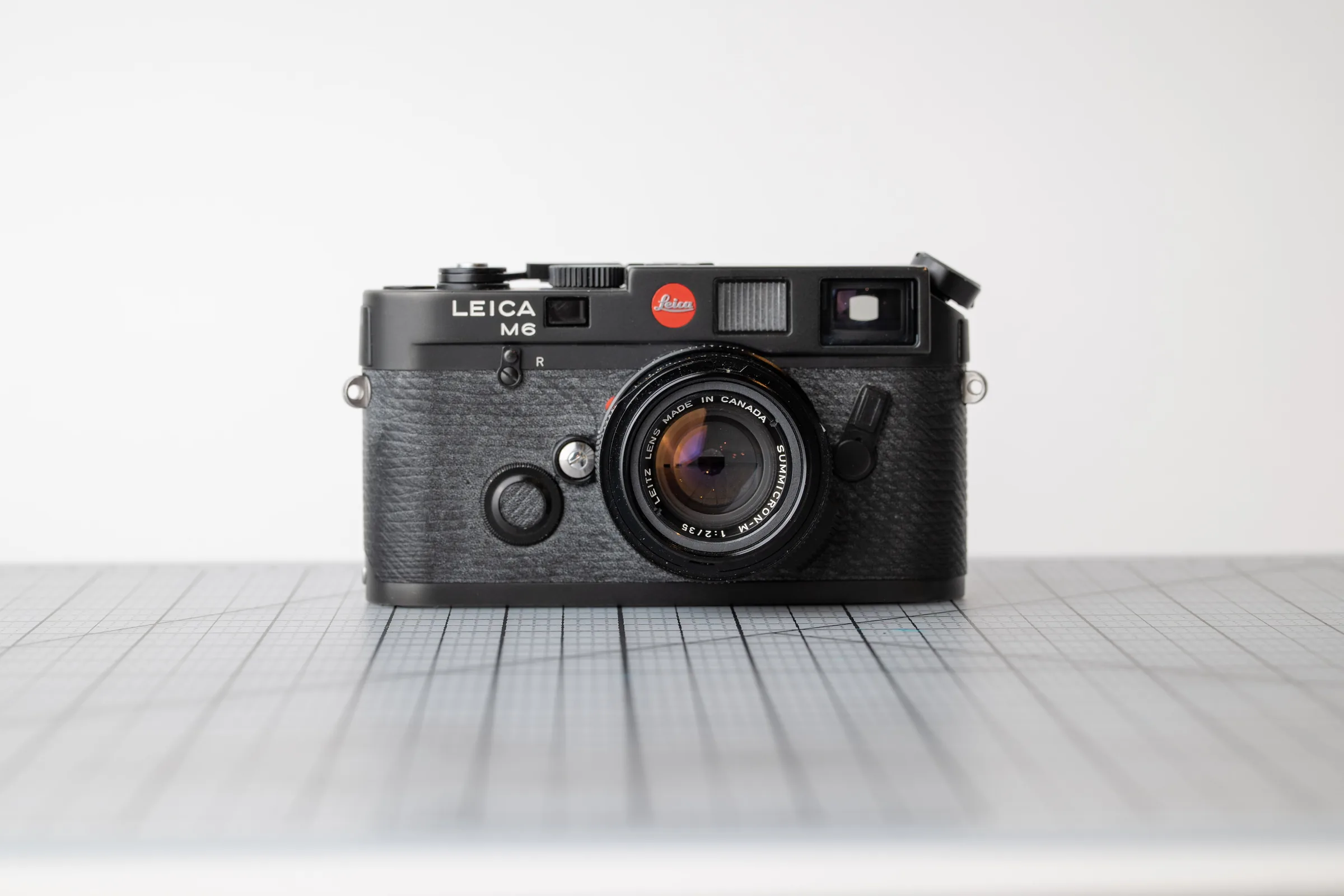
With a Canadian-made Leitz Summicron-M 35mm f/2. Photo: David Lee 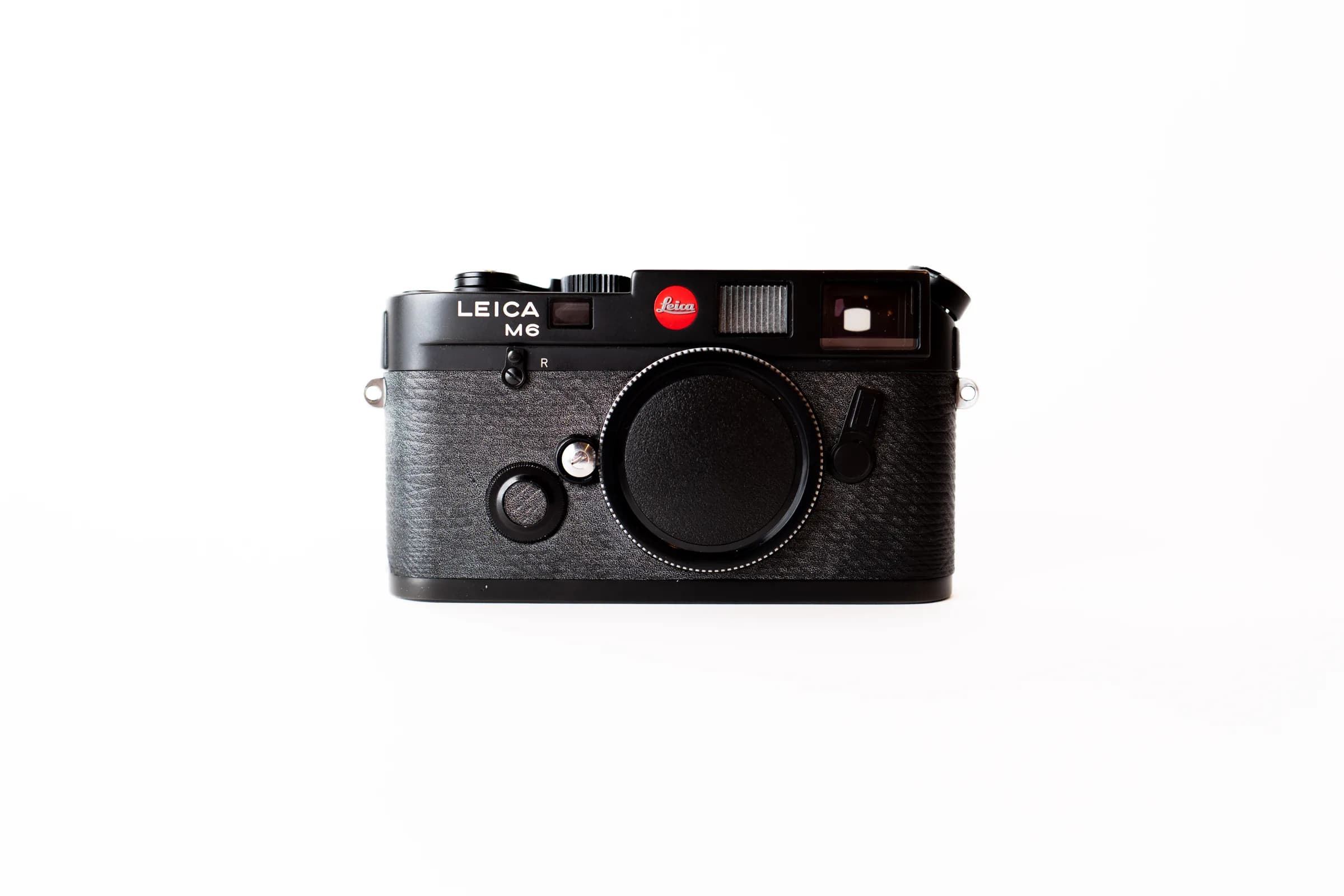
From the front, with the frame selector lever to the right of the lens mount. Photo: David Lee 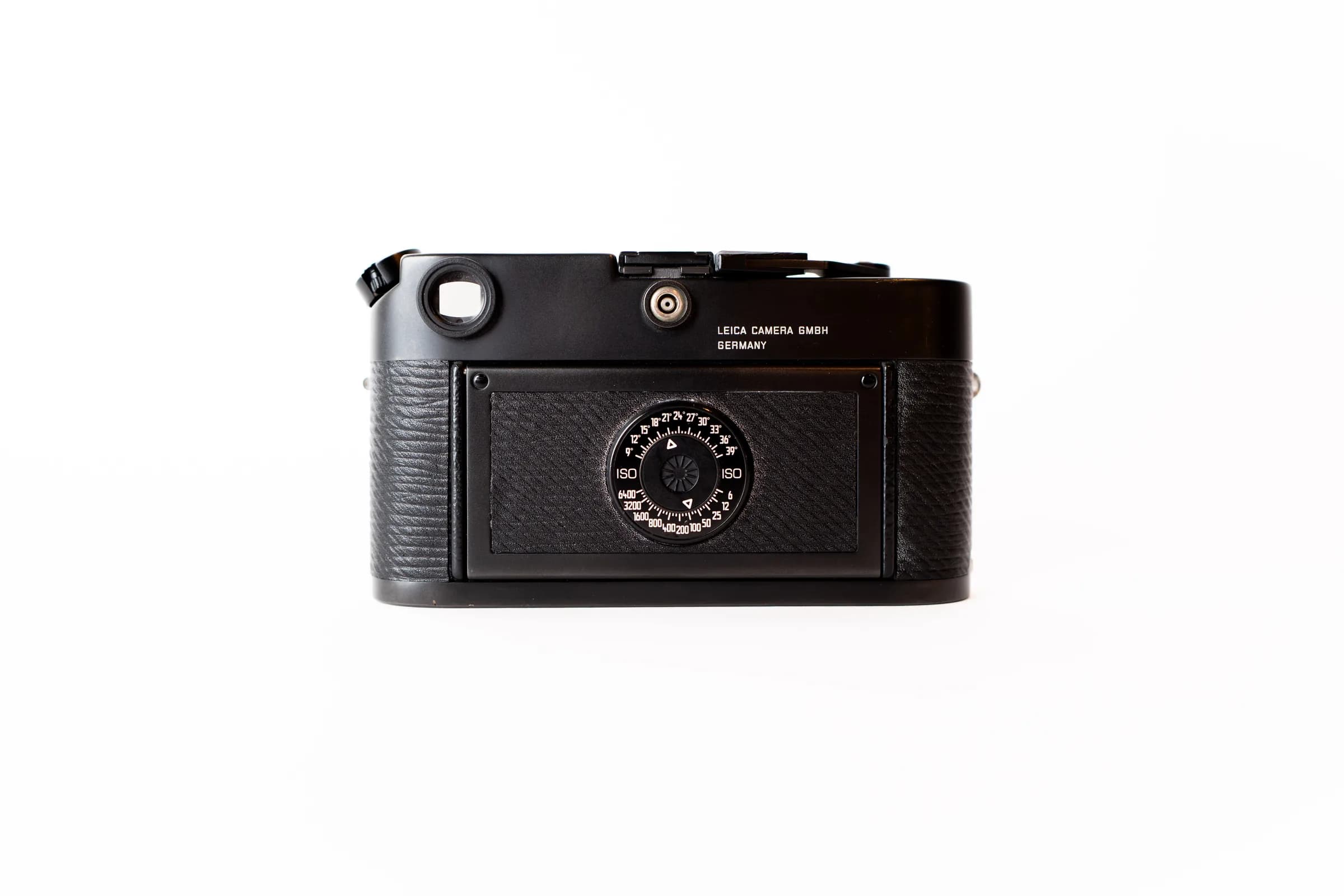
The back, with the film speed dial and the PC flash socket. “Leica Camera GmbH” means it was made before the company became Leica Camera AG in 1996. Photo: David Lee
Models
- Leica M6
- 1984–1999. Black chrome, the standard finish.
- Leica M6 silver chrome
- From 1986. The same camera in silver chrome.
- Leica M6 “Panda”
- 1990–1994. Silver chrome with black controls: shutter dial, wind lever, rewind knob and crank. After 1994 all the controls went back to silver.
- Leica M6 titanium
- From 1992. Light grey, scratch-resistant titanium-anodized metal and a real leather covering, sold with a matching titanium Summilux-M 35mm.
- Leica M6 0.85
- From 1997. A 0.85x viewfinder for more accurate focusing with longer lenses, with frames for 35, 50, 75, 90 and 135mm. Black chrome only. The only outside clue is “0.85” engraved on the strip under the viewfinder window.
- Leica M6 (2022)
- From 2022. The reissue, with a 0.72x viewfinder.
Special editions
1987
Leica Photographic Centre Zurich · 100 made
Black or silver chrome, with the optical diagram of the Elmar-M 50mm f/2.8 engraved on the top plate and a gold Leitz roundel. Under the base plate, “M6G” and a lot number are engraved in the film loading diagram.
1988
LHSA 20th anniversary · 43 made
The LHSA logo on the top plate between “1968” and “1988”, with edition numbers like 20-01 underneath.
Commissioned by Leica Historical Society of America
1989
150 Years of Photography · 1,250 made
Platinum plated, with grey karung leather and a matching Summilux-M 50mm f/1.4, in a mahogany box. Marks 150 years of photography and 75 years of Leica. Each camera carries one letter of the word Leica and a number from 1 to 250.
1992
Columbus 500th anniversary · 200 sets made
Engraved “500 Columbus ’92” and “500 Scoperta dell’America Italia”, sold with a chrome Summicron-M 50mm f/2.
Commissioned by Polyphoto, the Italian Leica agency
1993
Year of the Rooster · 300 made
A rooster and Chinese characters on the top plate, with a chrome Summicron-M 50mm f/2.
Commissioned by the Schmidt Group, Leica’s agent in the Far East
1993
Leica Royal M6 · about 102 made
Embossed red leather and engravings on the top plate and back, filled in red on silver chrome bodies and in white on black ones.
Commissioned by Fachfoto Royal, a dealer in Salzburg, for its 25th anniversary
1993
LHSA 25th anniversary · 150 sets made
Silver chrome with grey leather, sold with silver chrome Summicron-M 35, 50 and 90mm lenses engraved to match. The back of the top plate says “Special edition of 151 cameras”, and number 25-000 stayed in Leica’s museum.
Commissioned by Leica Historical Society of America
1994
Royal Photographic Society centenary · 100 made
Marks 100 years since the society was allowed to call itself Royal. The society’s coat of arms is on the top plate, and each comes in a light oak box with a booklet.
1994
Leica M6J · 1,640 sets made
Marks 40 years of the M system by mixing the M3’s looks and controls with the M6’s body, shutter and meter. It has a 0.85x viewfinder with frames for 35, 50, 90 and 135mm, and came with a new collapsible Elmar-M 50mm f/2.8. It was effectively the prototype for the M6 0.85.
1994
Sultan of Brunei
Gold plated, with the Sultanate’s emblem engraved on the top plate in red and black and a gold Summilux-M 50mm f/1.4.
Commissioned by the Sultan of Brunei, as gifts for guests
1994
Traveller Set · 200 made
A silver chrome M6 in black calfskin with a chrome Summilux-M 50mm f/1.4, plus a camera bag and attaché case in the same leather.
1995
Leica Historica · 150 made
Chrome with blue leather and a Summicron-M 50mm f/2, sold to members only.
Commissioned by Leica Historica, the German Leica society, for its 20th anniversary
1995
Polyphoto demonstration cameras · 90 made
Engraved “Demo unit for Polyphoto” with an outline of Italy, but with ordinary serial numbers.
Commissioned by Polyphoto, the Italian Leica agency
1995
Benelux demonstration cameras · 90 or 94 made
For dealers in the Benelux countries, engraved with a map of the region and “Leica Demo Ausrustung Benelux 96”.
1995
Dragon Edition · 300 made
A dragon engraved on the top plate, with an edition number out of 300 on the accessory shoe.
Commissioned by Schmidt Scientific, a dealer in Kuala Lumpur
1995
Danish Wedding · 200 made
For a Danish royal wedding, engraved with a crown, a monogram and the date 18.11.1995, with a matching Summicron-M 35mm f/2.
1996
Partner-Aktion Deutschland · 500 made
Demonstration cameras for German dealers, engraved with a map of Germany.
1996
Gold Thailand · about 700 made
Gold plated, with brown leather and a matching Summicron-M 50mm f/2, for 50 years of King Bhumibol Adulyadej’s reign. Thai Farmers Bank sold them in Bangkok and the money went to environmental projects in the city.
1996
A Piece of Leica · 996 made
Marks Leica Camera AG going public in September 1996. Covered in cowhide embossed with tiny Leica logos and sold with a black Summilux-M 35mm f/1.4 ASPH and a Leica share certificate signed by Sebastião Salgado, in a black wooden box.
1996
Schmidt Centenary · 150 sets made
Platinum plated with an Elmar-M 50mm f/2.8, in a rosewood box. The sets are numbered up to 188 but skip every number containing a 4, which is considered unlucky.
Commissioned by the Schmidt Group, for its 100th anniversary
1997
Anton Bruckner · 200 made
Platinum plated with grey-blue iguana leather and an Elmar-M 50mm f/2.8, for 100 years since the composer died. There are twenty cameras for each of his ten symphonies, numbered 01-01 to 10-20, and each came with a twelve-CD set of his music.
Commissioned by Leitz Austria
1998
Cartier-Bresson M6 · 1 made
Platinum plated and engraved with Henri Cartier-Bresson’s signature. Its serial number, 22-8-1908, is his birthday. It sold at Christie’s in London for £25,850 for the charity Les Petits Frères des Pauvres, in a case made by Louis Vuitton.
1998
Jaguar XK · 50 made
For 50 years of Jaguar’s XK sports cars. British Racing Green Connolly leather, the Jaguar mark and “XK 1948–1998” in green on the top plate, and an Elmar-M 50mm f/2.8 numbered to match.
Commissioned by Jaguar
1999
150 Years of Optics · 150 made
Platinum plated with grey snakeskin, for 150 years since Carl Kellner founded the optical institute that became Leitz. Each camera is engraved with one year from 1849 to 1999, and each 30-year group came with a different lens, from the Elmar-M 50mm f/2.8 to the Summilux-M 35mm f/1.4 ASPH.
Specs
- Lens mount
- Leica M
- Shutter
- Mechanical cloth focal plane, 1 s to 1/1000 s, plus B
- Flash sync
- 1/50 s
- Metering
- Center-weighted, 13% of the frame, with LEDs in the viewfinder
- Viewfinder
- 0.72x, or 0.85x on the M6 0.85 from 1997
- Frame lines (0.72x)
- 28/90mm, 35/135mm, 50/75mm
- Frame lines (0.85x)
- 35mm, 50mm, 75mm, 90mm, 135mm
- Battery
- Two SR44 cells or one 1/3N lithium, for the meter only
- Launch price
- $1,695 (1984). Before launch, the body was expected to cost about 3,000 Deutschmarks in Germany.
- Dimensions
- 138 × 77 × 33.5 mm (5.4 × 3.0 × 1.3 in)
- Weight
- 585 g (20.6 oz). Some sources give 560 g.
- Hot shoe
- Standard hot shoe with a single center contact, plus a PC flash socket
- Flash compatibility
- Any flash with a standard foot, used in manual or the flash’s own auto mode. There’s no TTL flash metering; that came with the M6 TTL.
- Launch price: Emulsive’s guide to the Leica M6
- Dimensions and weight: Leica M6 on Wikipedia
Lenses for it
- Leica Summilux-M 35mm f/1.4 ASPH FLE · 35mm f/1.4 lens for Leica M, 2010–2022
Known faults and repairs
Rangefinder patch flare
In bright light, especially with the sun off to one side, the rangefinder patch can wash out to white and make the camera hard to focus. It’s a quirk of the viewfinder design, and Leica only fixed it with the MP in 2003.
Fix: Leica and independent repairers can fit the MP’s rangefinder optics, which add a small lens that stops the whiteout.
Source: Andrew Nemeth’s Leica FAQ
Snapped shutter curtain
Eli’s used M6 had been fine for several rolls before it jammed on the first night of a trip to Tokyo. Opening it showed the shutter curtain stuck open, and it turned out the curtain had snapped.
Fix: It was repaired, and Eli later wrote that the M6 is “working like a charm”.
Reported by Eli Beaverson in Tokyo on Film
Where to get it repaired
- Leica Customer Care
Wetzlar, Germany. Leica’s own service. Book through the online form.
- Leica Camera USA
Teaneck, New Jersey, US. Leica’s own service in the US. Contact Customer Care before you send anything, and include Leica’s repair and service form.
- DAG Camera Repair
Wisconsin, US. An independent Leica and Minox repairer.
- YYE Camera
Massachusetts, US. Youxin Ye’s shop, which services Leica bodies up to the MP and fits the MP’s flare-free finder to M6s. Ask first whether your camera is covered.
We don’t have any arrangement with these shops. Ask about turnaround and price before you send a camera.
From our writers
The M6 gives me that pure, tactile shooting experience with film.
David Lee, in our Leica M11 review
As I got to frame nine of a roll of Lomography 800, I snapped a frame and went to advance the film. At this moment, the camera jammed up and wouldn’t advance. […] the shutter curtain was stuck in the open position – and as I came to find out much later, had in fact completely snapped.
Eli Beaverson, in Tokyo on Film
Manuals
External links
Sources
- Leica Pocket Book, 9th edition, Red Dot Photo Books